Showing posts with label sausage gets made. Show all posts
Friday, April 8, 2011
Friday, February 18, 2011
"you're not losing sales by having your stuff out there"
Neil Gaiman on why the understanding of the digital distribution of creative output needs to change -- and that change is clearly going to come through the creators themselves, not their publishers. Above is his quote. Also brilliant:
[via Boing Boing]
how many of you found your favorite authors by being lent a book?
[via Boing Boing]
Tuesday, November 9, 2010
[sausage gets made] we have a cast!
Remember those faces from our post about the script reading? They're all in. [Bonus points to anyone who can name them all. You, sir or madam, would be crowned a true off-off connoisseur.]
We're beginning our fundraising campaign which will be much more entertaining than my ramblings, but if you're a regular reader of this blog, you might have an inkling of the caliber of our productions.
Maybe you're ready to help us start a solid foundation on which to build without all the bells and whistles?
(Or, stay tuned for bells and whistles.)
Wednesday, September 22, 2010
Sausage Gets Made, continued [All's Fair (Six Western)]
It's been a while since we tracked the progress of our grant-winning development of All's Fair (Six Western). As we gear up for a 2011 showcase, here are some more conceptual designs by award-winning production designer Kina Park:
We've raised a bit of money, but there is so much more to be done. Join the endeavor and donate today.
Wednesday, September 15, 2010
Sausage Gets Made, continued [All's Fair (Six Western)]
It's been a while since we tracked the progress of our grant-winning development of All's Fair (Six Western). As we gear up for a 2011 showcase, here are some more conceptual designs by award-winning production designer Kina Park:
More to come next week...
Wednesday, September 1, 2010
let's stop the fussing and the feuding
COI's central computing unit has returned from its second sojourn at the sanitarium. On its way out, during its final session of the talking cure, the doctor thought it would be best to hash out some thoughts on healthier living to prevent a relapse.
Since the unit is the final repository for the COI podcast (readers of the blog have even seen it in action), grant application materials, playscripts, and input for this humble blog, it seems a prudent course of action.
Things we should do, but probably wont

Since the unit is the final repository for the COI podcast (readers of the blog have even seen it in action), grant application materials, playscripts, and input for this humble blog, it seems a prudent course of action.
Things we should do, but probably wont
- Not keep the COI podcast, grant application materials, playscripts, and draft blog articles in one place
- Use cloud computing services to keep said materials available [not until a tablet that ain't tethered to ATT comes out; lookin' at you, Verizon]
- Not live in the digital domain quite so much, return to paper notebooks
- Continue backing up data like it is a religious duty
- Treat the laptop as a fragile, valued, and expensive colleague, and fully acknowledge that it owns the entirety of our creative output so we'd better shape up

This time it's not Rudolph, it's sick.
Tuesday, August 31, 2010
"The world we're living is getting worse, not better."
Everybody line up for a wrist-smacking by the master:Today's dramatists are failing to confront issues of injustice, writing instead "for attention spans of 10 minutes between adverts", leading political playwright Athol Fugard has said.It's risky to decry changes in form as simply a decline in quality (I'm not sure I would still want to be doing day-long passion plays simply because that's how we started), I'm not going to discount the thoughts of someone whose work was so dangerous to the status quo it endangered the lives of that artist and his collaborators.
Fugard was a courageous dramatic voice throughout the apartheid era in his native South Africa, enduring censorship, police surveillance, phone-tapping and raids. He was the first to put black and white actors together on the South African stage.The first thing of note is that your correspondent's writing is not nearly at a level to change the world, as Fugard's did -- so I'm operating at a disadvantage. Second, I'm not sure that art has to be profound to be good. But in our short experience, we have found that the moment one's focus turns to the marketing of a play, or its reception, the immediate consequence is that the work itself suffers. What artistes so disdainfully call "commercial concerns" do threaten quality if only because the mind can't accommodate being both perceiver and perceived. So of course he's right.
Fugard, 78, is still writing and directing – a new play premieres in Britain this autumn. Speaking to the Guardian, he said he wants "to pass on the baton" to the next generation but is dismayed by a general failure to engage with political issues.
He applauded some of the "extraordinary" political work that has emerged from British and American theatre, singling out Sir David Hare for praise. But he added: "They're not doing enough … at the moment. The world we're living is getting worse, not better."
Playwrights are not adequately confronting subjects such as China's dictatorship and its new colonialism, which are "without significant protest", nor the decline of western morality, African leaders like Robert Mugabe, or drug abuse worldwide, he said.
[The Guardian]
Monday, July 19, 2010
congrats to the cast and crew of War Crimes
It's awards season for the second annual Planet Connections Theatre Festivity, and COItc will be making a return trip. Congrats to the following nominees:Sarah Hartmann Outstanding Actress in a Featured or Cameo Role of a Play
Mike Inwood Lighting Design
Sara Wolkowitz Outstanding Use Of Projections, Special Effects, AND/OR Multi-Media Event
Eunice Inquimboy Outstanding Postcard Design
Sergei Burbank Congeniality Award
(And, of course, huge congratulations to COItc Managing Director of Stage Leah Bonvissuto and Felipe Ossa on their multiple nominations for Cake. The smart money says they'll be running the table again this year....)
The awards ceremony will be August 1 at the Players' Theatre. Tickets and a full list of nominees are available here.
Thursday, June 3, 2010
A new episode is ready for download. Something a little different this time, as we chat with Leah Bonvissuto, Felipe Ossa, and Erin Leigh Schmoyer, three of the forces behind Cake, which opens on June 5th at 45 Bleecker, and is part of the Planet Connections Festivity.
This episode's got everything:

- Veiled references to sado-masochism
- Not-so-veiled threats for Ann Coulter
- A music preview from A Silent C, performing later this month at the BoCoCa Arts Festival
(1) Stream the episode below
(2) Visit our podcast page and listen online: conflicttheater.podOmatic.com
(3) iTunes users can click this link
Tuesday, May 25, 2010
sausage gets made, continued (war crimes)
Set pics from the second film shoot for our upcoming production of War Crimes:
Thursday, April 22, 2010
Sausage Gets **Funded** [All's Fair (Six Western)]
We interrupt our normal playwright's navel-gazing for this breaking news update -- the developmental workshop of All's Fair (Six Western) is now the recipient of a seed grant from the Puffin Foundation!
We still have a long way to go before we're on our way to Washington State, but it's a rip-roaring start -- and if strangers can get us so far, imagine what a little help from a lot of our friends can do? Donate here.
Monday, April 5, 2010
Sausage Gets Made, continued [All's Fair (Six Western)]
Part of COItc's pipeline for 2010-2011 includes development of the new play All's Fair (Six Western), the recipient of a performance residency at Centrum (Port Townsend WA). Throughout the year, we hope to post the thoughts of various members of the development team and track its progress.
Below, the playwright continues to recall some of the thought process behind the work. (Part Three is here.)
Our first group meeting was in a dim coffee bar just south of Union Square -- Kina had been there, of course, long before us, and tucked in the corner I think we all would have waited patiently for hours not noticing that we were all met. We're a bunch of rather meek tragedians.
It's incredibly breathtaking when you've written a script and bit by bit other people start fleshing out your vision. With well over a year to go before any of this would be realized, it was jaw dropping (not least to the other bar patrons who suddenly had an art exhibit on their hands).
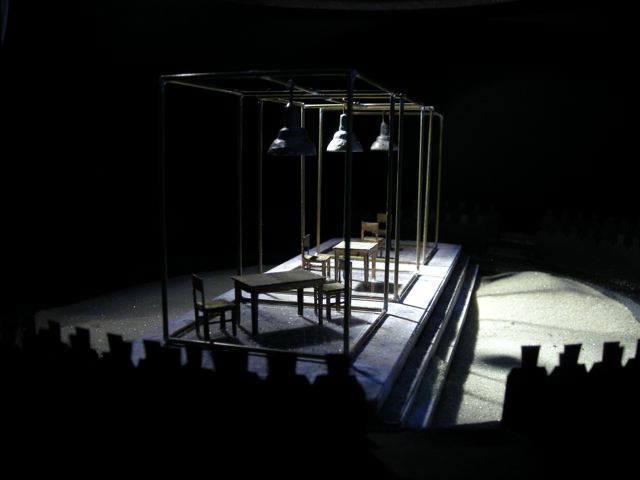
The world of the play was coming together. Now we needed to hear it, and figure out if the script would make any sense at all.
Below, the playwright continues to recall some of the thought process behind the work. (Part Three is here.)
Our first group meeting was in a dim coffee bar just south of Union Square -- Kina had been there, of course, long before us, and tucked in the corner I think we all would have waited patiently for hours not noticing that we were all met. We're a bunch of rather meek tragedians.
On top of that, COItc is a very small circle of meek folk; Leah had recommended Kina to me for Timor Mortis, but this was the first time they had collaborated on a piece. I'm always nervous bringing together people who I work with well -- my working relationship is not a guarantee of smooth sailing for everyone involved.
Leah and I had been chatting informally about the play and how we could stage it off and on for weeks. One idea that had evolved was having three playing spaces isolated from each other; in her napkin sketches, Leah had drawn three squares in a row, rotated 45 degrees. It had solidified over time, and it was one of the first items that made me nervous about our meeting.
Kina has an incredibly flexible mind -- she's designed shows for us with fully built frames and shows on poster board -- but what designer wants to have a playwright and director say this is how we think you should approach your job? [I'll pause as all designers say in unison, "That's exactly what happens."]
We launched into our discussion; eventually, Leah got to her ideas on spacing, on staging. She flipped to a blank page in the script and drew the squares. Here was the test. I shot a look over to Kina, who I find rather hard to read sometimes. She looked blankly at Leah's sketch, opened her script ... and revealed her own sketch depicting pretty much the same thing. This was going to be a lot of fun.
Our next meeting was in a hole-in-the-wall wine bar which is fun for atmosphere but not so much when it comes to working meetings with over-achievers. Leah and I expected maybe some sketches ... Kina arrived with a HUGE white box which contained a fully realized model of the set. With sand.
It's incredibly breathtaking when you've written a script and bit by bit other people start fleshing out your vision. With well over a year to go before any of this would be realized, it was jaw dropping (not least to the other bar patrons who suddenly had an art exhibit on their hands).
The world of the play was coming together. Now we needed to hear it, and figure out if the script would make any sense at all.
Friday, April 2, 2010
commercialism
You might have noticed a new advertisement (disguised as a widget) over to the right there.
Our friends at the Planet Connections Festivity -- where our production of War Crimes premieres this June! Buy your tickets now! -- are currently in the running for a Pepsi Refresh Grant through the Pepsi Refresh Project.
You get 10 votes per day to vote for your favorite submitted idea, and at the end of the month, the top 10 ideas with the most votes in each funding level will get the funding they requested. If PCF obtains this funding, they'll be able to "green the festivity" (green is a verb now) and make the festivity as a whole a fantastic, eco-friendly experience.
And the puppy wont have to die.
Do what's right, America. Do what's right.
Monday, March 29, 2010
Sausage Gets Made, continued [All's Fair (Six Western)]
Part of COItc's pipeline for 2010-2011 includes development of the new play All's Fair (Six Western), the recipient of a performance residency at Centrum (Port Townsend WA). Throughout the year, we hope to post the thoughts of various members of the development team and track its progress.
Below, the playwright continues to recall some of the thought process behind the work. (Part Two is here.)
The details of why I shared the script with Leah elude me, but I do remember quite clearly that it pissed her off. Now that I think about it, we were running up against a submission deadline, and being nowhere near done on anything else at the moment, I grasped for the AF(SW) script simply because it was a completed, if disastrous, draft. Leah was decidedly annoyed she hadn't been shown it before.
As Managing Director of Stage for COItc, Leah more or less has free reign of all my work as an assumed add-on; I didn't want her to feel I was holding out on her. At the same time, I didn't feel compelled to shovel shit onto her desk, which is what I felt this was.
Leah had other ideas.
The most exhilarating aspect to this group has been the evolution of our aesthetic; I can't define it quite yet, but it's there. Timor Mortis, McReele, and The Danish Mediations/slots had different directors and designers, but they nevertheless held our company's stamp, somehow. And one thing I've learned to trust is that if I don't like a script on the page, I can throw it into the middle of the group and watch something remarkable happen. Leah's gut told her she could do something with this script. As anyone who's worked with her knows, it's a mistake to doubt her judgement.
As just as it had been born out of some desire to stretch the framework of showcase performance infrastructure, in discussions Leah and I found that we were mutually tired of the entire showcase process, start-to-finish: the limitations of COItc's budget and schedule made every aspect of the process feel rushed. We wanted to do something that took its time, was better considered, and had time to breathe.
In the truncated timeline which had developed over time, the various aspects of production were stacked over each other in a haphazard fashion: the hiring of actors and designers were to distinct processes that occurred simultaneously, but without any discussion between the two groups until later in the process. That, we both decided, needed to change. Instead of parallel tracks, we were going to get a designer months in advance to help us create a world for the actors to step into from day one.
For that, we needed a designer who not only shared our mutual aesthetic seamlessly, but who had an appetite for a really intimate, long-running discussion about an incredibly wacky setup to begin with; someone who for practically no money at all and very little to show for it in the months -- up to a year -- to come, would still throw him or herself in headfirst. We needed a nut. One of us.
We needed Kina.
Wednesday, February 24, 2010
Sausage Gets Made, continued [All's Fair (Six Western)]
Part of COItc's pipeline for 2010-2011 includes development of the new play All's Fair (Six Western), the recipient of a performance residency at Centrum (Port Townsend WA). Throughout the year, we hope to post the thoughts of various members of the development team and track its progress.


Below, the playwright continues to recall some of the thought process behind the work. (Part One is here.)
I'm not quite sure how Neil Patterson came into being. He's not based on any one person. As depressing as it is to think that we've not been at war in Iraq and Afghanistan long enough to subdivide it into eras, there was a time in the first stages after the fall of Saddam Hussein and the Taliban when the overwhelming narrative was that of soldiers and contractors kidnapped and executed by insurgents. (It's still happening, but we don't pay much attention anymore.)
The story then was that of the armed forces of a helpless giant besieged on all sides by hostile Lilliputians who would be our undoing through many isolated--albeit barbaric--fatalities. Vietnam redux.
What struck me was how quickly those hostages disappeared from our collective view after their deaths or repatriations. Their only value was when they were in the most distress; we considered very little for them or their families after the crisis was over, one way or another. This is to be expected in our celebrity-addled times, but it seemed particularly psychotic when it came to things like war. Trapped coal miners and babies dropped down wells might be satisfied, even eager, to return to obscurity after their rescue. If the traumas of returning soldiers were anything to go on (another largely ignored narrative, because untidy), those held hostage by Islamic extremists and lucky enough to escape might have a bit more difficulty readjusting.
And while there were events in the news that no doubt inspired the plot, but the real backbone of the play, the real thrust behind the writing, were the characters around Neil, and my experience bringing them to life made me throw this script in a drawer for two years.
Some of the dialogue for my scripts starts as disembodied voices arguing in my head. My favorite parts of All's Fair (Six Western) were born when I started hearing Emily, Jane, and Cherien sparring in the back of my head beyond my control. So, like I always do, I just started transcribing their argument and tried to drape a story around them.
There was something different this time in their voices, though: I was hearing the distinct characteristics of specific actors I'd worked with -- this was something new.
I got into playwriting, if it can be believed, for more egotistical and self-serving reasons than the ones I have for pursuing it: I begin writing lines for my own voice, trying to give myself the parts I wasn't finding in auditions. (The Third Seat was assembled from the zombified remains of my first ever attempt at playwriting in 2003; the first draft was truly cringe-worthy.)
For the first time, the characters I started developing for AF(SW) weren't abstract -- they were based on performers I truly enjoyed working with; sentence cadences were starting to mold to their habits -- for more practiced playwrights I know that this is not an epiphany, but I felt like a painter discovering a whole new kind of brush; it was exhilarating.
I hastily slapped together a draft and dragged some actors into a studio. From 2003 to 2007 I had used the page as my primary laboratory, but after Danish I couldn't even get a full picture of the piece without hearing it out loud. And in the writing for this one, I had literally composed it for specific performers. It was inconceivable that the process could go one more step without their input. These were characters for them; was like a tailor assembling the materials for a custom-made suit: I needed measurements, color swatches, allergies.
So it was a special thud in the pit of my stomach when one of the performers for whom I'd written a role flipped the last page over and said, I don't really get it.
Laurel Lockhart and Roy Clary at the Third Seat first read. This is after I started photographing the carnage.
The first problem was probably that I had tried to drape the script over the episodic roll-out I'd conceived as a way to enhance an audience's engagement with the production. Trying to make a story that ostensibly would unfold over the course of two hours sustain itself for four weeks is a challenge in and of itself, compounded by the fact that my writing style in the best of times tends to be rather condensed. A frequent complaint from actors is that I often don't provide enough of a justification in text for the leaps of faith and about-faces my characters make.
Since my instinct was to be the anti-soap opera (half-submerged objectives, quick changes, non sequiturs), how could I have plausibly created a script that was, for all intents and purposes, a live soap opera?
The short answer is that I hadn't. But I thought I did. There, on the second page, was a pretentiously worded breakdown of pages, purposely indecipherable because even I didn't know that it meant:

But it sure looked like I knew what I was doing. Until we were done reading and people started asking questions.
So -- the first week -- people just leave after page 67? And then they come back and don't have any idea what's going on?
This character doesn't do anything. There's no justification for her making this choice.
I don't get it.
This was my first experience with developing a piece with other people; up until now I had worked in seclusion, not showing drafts to anyone else, and in my one single experience of producing, had held all the purse strings, and thus had final say. I had never opened my scripts up for scrutiny before we had a chance to rehearse and refine. And yet I had thought in my arrogance that these performers would be so flattered by my writing for them that they would not see this first draft for the flawed text that it was.
I had a lot to learn. A lot to process and refine. A lot of ways to get better. So, I did what any mature and self-possessed artist would do.
I threw the script in a drawer and left it there for two years.
Tuesday, February 23, 2010
news that is not news
To begin with, all the items in Patrick Healy's gays are just like us theater trend piece in the NYT are positive ones.
A new breed of plays and musicals this season is presenting gay characters in love stories, replacing the direct political messages of 1980s and ‘90s shows like “The Normal Heart” and “Angels in America” with more personal appeals for social progress.
These productions about gay life make little or no mention of H.I.V. or AIDS and keep direct activism at arm’s length, with militant crusading portrayed with ambivalence more than ardor. The politics of these shows — there are seven of them opening in New York in the next several weeks — are subtler, more nuanced: they place the everyday concerns of Americans in a gay context, thereby pressing the case that gay love and gay marriage, gay parenthood and gay adoption are no different from their straight variations.
All well and good, but not only are these points blindingly obvious (the Times is rather good at catching on late and pimping illegal wars, after all), Healy neglects two key changes over time:
- the increasing maturity of audiences to deal with gay characters being more than people who sleep with the same sex; and
- the slowly dawning realization on the part of theatrical producers that they can fund works that portray gay characters with simple humanity and still make money (see point number 1).
It seems to me Duncan Pflaster's pithy post here provides a far subtler and perceptive analysis in a tenth of the space. But his argument assumes a continuum between audience and playwright, and a market to be supplied -- rather than the received aesthetic of whatever theaters the Times deigns to populate.
What is disheartening is Healy's unstated assumption that gay characters in theater must be placed there for exclusively political reasons. It's particularly galling to this playwright because the portrayal of brown-skinned characters has gone through this same evolution (or, I should say, audiences and producers have evolved along similar lines vis รก vis brown-skinned people onstage) and the same assumption prevails: if a character treads the boards who happens to be gay / brown / lack a penis but possesses any crumb of agency, they must have been placed there because the playwright has a point to make.
Why can't a playwright simply want to tell a story using people who exist in the real world?
Overall the piece has this tone (like so much of the Times) well-suited to quietly assure the elite that change wont essentially threaten their privilege. Honestly, is there a better article to send your great-aunt Edna out on Long Island -- you know, the one who hasn't been to New York since 1974 when that black guy looked at her funny on the street and scared her half to death -- to convince her to come see a show?
Credit where credit is due, however: Healy does briefly note that despite the more even-handed portrayal of gay people onstage, those characters are still overwhelmingly male. There are hierarchies, even amongst society's untouchables...
Tuesday, February 16, 2010
Sausage Gets Made, continued [All's Fair (Six Western)]
Part of COItc's pipeline for 2010 includes development of the new play All's Fair (Six Western), the recipient of a performance residency at Centrum (Port Townsend WA). Throughout the year, we hope to post the thoughts of various members of the development team, and track its progress.


Below, the playwright recalls some of the thought process behind the work.
Can anything fruitful be born out of spite? Because to be honest, the first spark of what became all's fair (six western) came in 2007, sitting in the darkened lobby outside our inaugural production, The Danish Mediations, thinking about how much Actor's Equity pissed me off.
Being my first time around as a producer, everything about the process was strange to my eyes: Why did the showcase code cap the production budget and number of performances? Why didn't the code demand that producers share box office proceeds with Equity members (something we nevertheless did)?
I avoided going in to performances -- even performances with only four or five audience members -- because watching half a dozen imprisoned actors forced to mouth my words was pure hell. Since I also worked the door, those duties provided the perfect excuse to avoid going in, settling the cash box (even scant audience numbers taxed my math-deficient brain), setting up (and eating) the concessions, etc.

Jason Updike (of COI podcast fame) plays, essentially, me with Jason Altman and Gary Patent in The Danish Mediations (2007).
There were long stretches where I lay back in the dark, waiting for the act break or curtain call, and wondered what we thought we were doing. Nestled in a black box theater carved out of a cluster of SoHo apartments, the Access Theater is run by a friendly and committed staff -- but it's a fourth floor walk-up from its nondescript entrance at street level. There were many nights when I wondered how it must have looked from the outside, everyone killing themselves to create this polished theatrical piece which we promptly hid from public view as best we could.

Group photo of COI West Chapter; Gary Patent and Fayna Sanchez, both now of LA, in COItc's inaugural production.
The image etched most indelibly in my memory was the sight of audience members arriving at the fourth floor landing: out of breath, sweaty, and weary even before the show had begun. It was an extreme case, but I thought it was a fit image for many audience members in independent theater: while usually not as efficient at burning calories, it's still not easy to follow a particular company or actor or playwright before they've landed in the more comfortable niche of established off-Broadway companies. Aside from those who are extremely committed to attending live theater (who, like the mildly autistic who chart regional trains for the pleasure of checking a schedule, I find charming and creepy in equal measure), it's work for an audience to attend a show. Most people are tired from their day jobs, confused by traveling to obscure venues, hungry for a deferred meal. And I worried that the payoff was too fleeting to justify the output of energy.
How, I wondered in the dark lobby waiting for intermission, could we change the model? How could I offer an audience a more comprehensive experience? How could we increase their return? I was starting to get an idea.
To begin with, I had to take the asinine limitations of the Showcase Code as a given. It was a red herring to start bitching about the restraints placed upon producers by AEA's profit- and job-killing restrictions; sure, they are both of these things -- but that kind of woe-is-me thinking is counter-creative, it just affirms navel-gazing laziness. It's here, it's the rules. I needed to get over it.
But how could I increase the return on an audience's experience while staying inside the restrictions of a four-week Showcase run of 16 performances and a (since-revised) budget cap?
The set had to stay the same. The cast had to stay the same. But something had to be different, so the only thing left was the script. We had to create a serialized piece that could be laid out over four weeks -- one new segment a week. At the same time, I wanted to avoid a live-action soap opera: the plot had to be contained, whether an audience member chose to view all four segments or only one, they had to have a satisfying theatrical experience.
Moreover, the experience had to be informed by the segmentation -- we couldn't have it take four weeks to do the play simply because of a high page count. I had no idea what kind of story would work, though...
(continued)
Subscribe to:
Posts (Atom)